

Many new traders use the same stop on every trade, say 30 or 50 pips. The problem is that markets don’t always move the same amount. A 50-pip stop that makes sense on a quiet day can be far too tight when the market gets choppy. An ATR stop loss solves this by letting the stop distance follow current volatility.
This article explains how ATR works, the ATR stop formula, a worked 1.5x ATR example with round numbers, and how it compares with a fixed-pip stop. All figures in the examples are hypothetical and for learning only, not trade signals or recommendations.
What is ATR?
ATR (Average True Range) is an indicator that measures the average size of price movement over a set period, including gaps between candles. Each candle has a true range, which is the largest of three numbers:
- the high minus the low of that candle,
- the absolute difference between the high and the previous close,
- the absolute difference between the low and the previous close.
ATR is the average of the true range over N candles. The most common default is 14 periods. On a daily chart, ATR(14) is the average daily range over the last 14 days.
ATR shows size, not direction. A high ATR only means the market is moving widely, not that price is rising. A low ATR means smaller moves, not that price is falling.
The ATR stop loss formula
The idea is simple: place the stop a multiple of ATR away from your entry price.
- Long position: Stop = Entry − (ATR × multiplier)
- Short position: Stop = Entry + (ATR × multiplier)
The multiplier is a number you choose. With a multiplier of 1, the stop sits just one “normal move” from entry, so ordinary fluctuation can reach it. That’s why many guides suggest at least 1.5 to 2x ATR. In strongly trending markets, some traders use wider multiples of about 3 to 4x to give a trade room to move.
There is no single “correct” multiplier. It depends on the instrument, timeframe and style, and it should be tested on a demo account or historical data first.
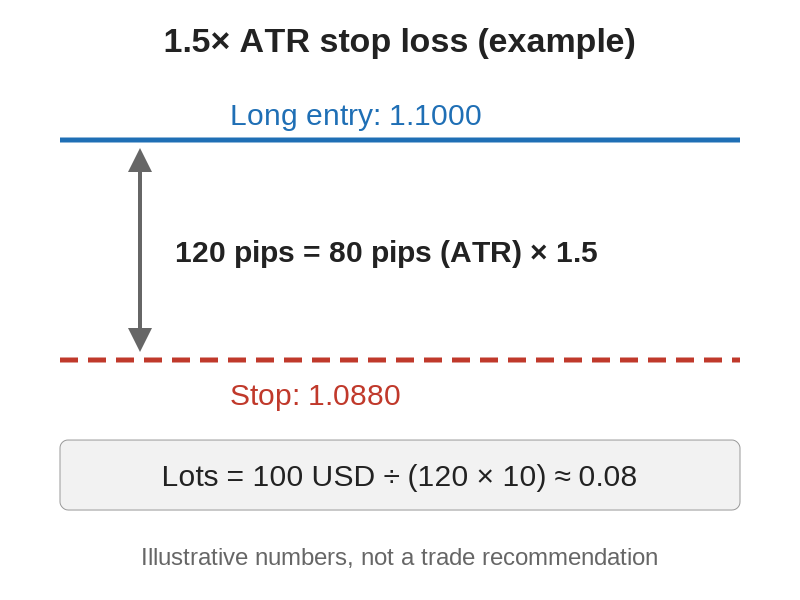
Worked example: 1.5x ATR
Take this hypothetical scenario on EUR/USD, daily timeframe:
- ATR(14) = 80 pips (0.0080)
- Long entry price = 1.1000
- Multiplier = 1.5
Step 1: calculate the stop distance. 80 pips × 1.5 = 120 pips (0.0120).
Step 2: find the stop price. For a long position: 1.1000 − 0.0120 = 1.0880. For a short position at the same entry: 1.1000 + 0.0120 = 1.1120.
The 120-pip stop sits beyond the average daily range (80 pips), so ordinary movement doesn’t automatically reach it. But a wider stop also means a bigger loss per lot if it is hit, so position size has to adjust.
Adjusting lot size
Assume a hypothetical 10,000 USD account risking 1% per trade, which is 100 USD. On EUR/USD, one pip on a standard lot is roughly 10 USD.
Step 1: risk per lot = 120 pips × 10 USD = 1,200 USD. Step 2: lot size = 100 ÷ 1,200 = 0.0833 lots. Step 3: round down to 0.08 lots. Actual risk: 0.08 × 120 × 10 = 96 USD.
A wider stop doesn’t automatically mean more risk. What changes is the position size. This is covered further in how to set a stop loss based on a percentage of your account.

ATR stop vs fixed-pip stop
Suppose you always use a 50-pip stop. Here is what happens as ATR changes (all numbers hypothetical):
| Market condition | ATR(14) | Fixed stop | 1.5x ATR stop | Lots for 100 USD risk (ATR stop) |
|---|---|---|---|---|
| Quiet | 40 pips | 50 pips (1.25x ATR) | 60 pips | 0.16 lots |
| Normal | 80 pips | 50 pips (0.63x ATR) | 120 pips | 0.08 lots |
| Volatile | 120 pips | 50 pips (0.42x ATR) | 180 pips | 0.05 lots |
How the last column is calculated: 100 ÷ (stop distance × 10). For 60 pips: 100 ÷ 600 = 0.1667, rounded down to 0.16 lots. For 180 pips: 100 ÷ 1,800 = 0.0556, rounded down to 0.05 lots.
Two things stand out:
- A fixed stop is inconsistent. At an ATR of 40 pips, a 50-pip stop is wider than the normal range. At an ATR of 120 pips, the same stop is only about 0.42 ATR and is easily swept by noise.
- An ATR stop “breathes” with the market. It tightens when the market is quiet and widens when it is volatile. Lot size shrinks in volatile markets, so the money at risk stays near 100 USD.
A fixed-pip stop still has its strengths: it is quick, simple and consistent. But it ignores changes in the volatility regime, which is exactly what the ATR approach addresses.
Limits and things to watch
An ATR stop doesn’t guarantee you won’t be stopped out. Keep these points in mind:
- ATR is backward-looking. It measures volatility that has already happened. Releases like NFP or interest rate decisions can move price far beyond ATR within minutes.
- Slippage and gaps. In fast conditions a stop can fill at a worse price than the level you set.
- Wide stops need small lots. Using a wide ATR stop with a large fixed lot size inflates the risk per trade.
- Leverage raises risk. Most retail traders lose money trading leveraged products. A well-placed stop manages risk but does not remove it.
- Match it to the instrument. ATR behaves very differently for gold, stock indices and crypto than for major currency pairs. Don’t copy a multiplier from one market to another without testing.
Combining ATR with price structure
Many traders don’t use ATR alone. They place the stop just beyond the nearest swing high or swing low, then add a buffer of a fraction of ATR so the stop doesn’t sit right on a level that often gets swept. Structure is covered in how to set a stop loss based on support and resistance. For another angle, read how to set a stop loss based on price volatility and a time limit.

Putting an ATR stop into practice
- Add the ATR indicator to your platform and choose a period, usually 14.
- Match the ATR timeframe to the timeframe you trade. A daily ATR doesn’t suit M5 scalping.
- Pick a multiplier (for example 1.5 or 2) and test it on historical data or a demo account.
- Calculate the stop distance in pips, then work out lot size from your chosen risk percentage.
- Keep a record. Review whether your multiplier is too tight (stopped out often) or too wide (risk-to-reward gets worse).
For the basics, see what is a stop loss, 3 rules to follow when using stop loss orders, and the lesson page on setting stop losses. If you trade on margin, also understand what a stop out level is, since a broker can close positions automatically before your own stop is reached.
FAQ
Which ATR multiplier should I use?
There is no single correct number. General guidance suggests at least 1.5 to 2x ATR, because 1x ATR is easily reached by normal movement. In trending markets some traders use 3 to 4x. Test it on a demo account before using it on a live one.
Is an ATR stop loss better than a fixed-pip stop?
An ATR stop adapts to volatility while a fixed stop does not, which is its main advantage. But it doesn’t guarantee better results: it can still be hit, and it has to be paired with correct lot sizing.
What ATR period is most common?
ATR(14) is the most common default. A shorter period such as 10 reacts faster to changes in volatility, while a longer one such as 20 is smoother. Choose based on your timeframe and trading style.
An ATR stop loss lets you set your stop distance from market conditions instead of guesswork. To keep learning risk management step by step, start with the forex education course.
Disclaimer: this article is for education and market information only. It is not investment advice or a recommendation to buy or sell any asset. Trading forex and other leveraged products carries a high risk of losing some or all of your capital.