

Revenge trading is the impulsive urge to open another position right after taking a loss, driven by the desire to win back lost money as quickly as possible. Instead of following objective analysis, the entry comes from anger, frustration, or bruised ego—acting as if the market owes your account a refund.
This habit is one of the fastest ways retail traders drain leveraged accounts. In its March 2018 product intervention announcement, the European Securities and Markets Authority (ESMA) reported that 74% to 89% of retail CFD and forex accounts across the EU typically lose money. Excessive leverage and emotional decisions such as revenge trading make those losses grow faster.
Why Revenge Trading Happens Psychologically
Chasing losses is rarely just about impatience. In trading psychology, the urge links directly to loss aversion and the reflection effect described in prospect theory. A peer-reviewed study of online forex and commodity trading accounts published on PubMed Central (NIH) found that traders tend to avoid risk when holding winning positions, yet become far more risk-seeking when facing losses in an attempt to break even.
After two or three consecutive stop-outs, the brain treats financial loss as an immediate threat. Attention shifts from “does this setup meet my criteria?” to “how do I erase today’s red number before the session closes?”
That shift leads traders to double lot sizes, force entries on lower timeframes without confirmation, or widen stop losses. With leveraged instruments like forex, a single emotional hour can wipe out weeks of disciplined execution.
Warning Signs You Are Revenge Trading
Catching the pattern early is far easier than trying to stay calm after a steep equity drop. Watch for these concrete red flags during a session:
- Opening a new trade minutes after a stop-out without waiting for a candle close or a fresh, valid setup.
- Increasing lot size above your position sizing rules in hopes of recovering prior losses in one trade.
- Jumping to unfamiliar currency pairs or lower timeframes (such as dropping from H1 to M1 or M5) just to manufacture a quick entry signal.
- Removing or widening a stop loss while price moves against you because you refuse to book another loss.
- Physical tension and tunnel vision, such as a racing pulse, clenched jaw, or staring at floating profit and loss instead of price structure.
When two or more of these signs show up in one session, the issue is no longer your technical edge—it is your mental state.
The Math Behind Revenge Trading and Account Drawdown
Losses and recoveries are mathematically asymmetrical. The deeper the drawdown you allow in a single day, the larger the percentage gain required simply to get back to breakeven.

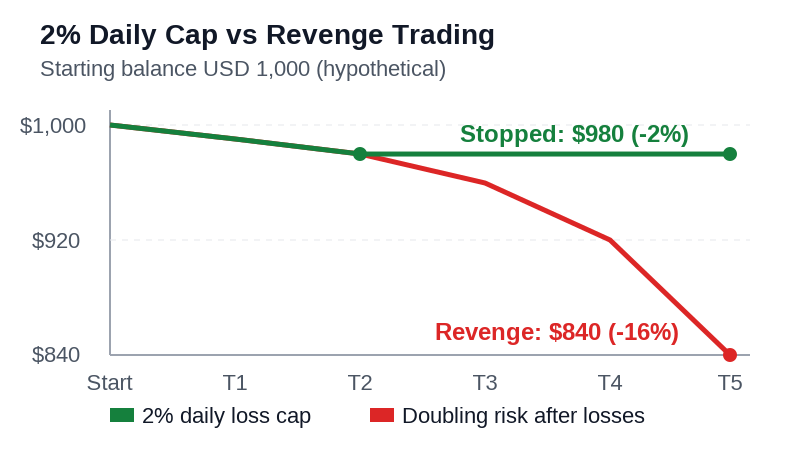
Take a hypothetical example: a trader starts with a USD 1,000 account, normal risk of 1% per trade (USD 10), and a 2% daily loss limit (USD 20). Compare two paths after two consecutive losing trades:
| Trade Sequence | Disciplined Path (2% Daily Cap) | Revenge Trading Path (Doubling Risk) |
|---|---|---|
| Starting balance | USD 1,000 | USD 1,000 |
| Trade 1 (loss) | -USD 10 (USD 990 left) | -USD 10 (USD 990 left) |
| Trade 2 (loss) | -USD 10 (USD 980 left) | -USD 10 (USD 980 left) |
| Trade 3 (loss) | Stop for the day (USD 980) | -USD 20 (USD 960 left) |
| Trade 4 (loss) | Stop for the day (USD 980) | -USD 40 (USD 920 left) |
| Trade 5 (loss) | Stop for the day (USD 980) | -USD 80 (USD 840 left) |
| Total daily loss | -2% (-USD 20) | -16% (-USD 160) |
| Gain needed to break even | 2.04% (USD 20 / USD 980) | 19.05% (USD 160 / USD 840) |
The gap is stark. Stopping at the 2% cap leaves you needing just a 2.04% gain to return to USD 1,000. Three emotional trades with escalating lot sizes turn a routine setback into a 16% loss that requires nearly 20% net return just to get back to where you started.
Hard Stopping Rules: Daily Loss Limits and Cooldowns
Promising yourself to “stay calmer next time” rarely holds up when your screen is red. You need hard, pre-committed stopping rules written down before the session begins.

1. Set a Fixed Daily Loss Limit
A practical circuit breaker is a maximum daily loss of 2% to 3% of account equity—or two to three full-risk losses. If you follow the rule to never risk more than 2% per trade (or a more conservative 1% per trade), two consecutive 1% losses hit your 2% daily cap automatically.
Pair your daily cap with a weekly loss limit, such as 5% to 6%. Once that threshold is reached, trading stops regardless of how tempting the next candle looks.
2. Enforce a Mandatory Cooling-Off Period
Whenever you hit your daily limit or suffer two consecutive losses, close your trading platform at least until the next trading day. Step away from the charts, mute price alerts on your phone, and avoid watching the pair that just stopped you out.
Using objective risk placement from the start—such as an ATR-based stop loss that adapts to market volatility—also removes the temptation to micromanage or widen stops mid-trade.
3. Return Decisions to Your Trading Plan and Journal
Once your emotions settle, review your trading plan to check whether the losses were a normal part of strategy probability or the result of breaking rules. This is where reviewing your trading journal acts as an objective mirror.

Log more than entry and exit prices: record your emotional state before clicking, whether position size matched your rules, and how much time passed since the previous trade. Over time, building trading discipline from journal data makes emotional triggers easy to spot before they snowball.
Pre-Trade Checklist After a Losing Streak
Before placing your next order in the following session, confirm every item below:
- Your previous losses and their causes are fully logged in your trading journal.
- Position size for the next trade stays at your standard risk percentage—never raised to recover yesterday’s loss.
- The setup satisfies every written condition in your trading plan rather than satisfying an urge to be in the market.
- You accept the full predefined stop loss on this trade without moving it if price turns against you.
FAQ
What is a sensible daily loss limit to stop revenge trading?
Many risk management guides suggest capping daily losses at 2% to 3% of account equity, or two to three losing trades at 1% risk each. That cap is small enough to keep your account intact while acting as a firm emergency brake before emotions take over.
Should I switch to a demo account right after hitting my daily loss limit?
It is better to step away from the charts completely for several hours or until the next trading day. Switching to a demo account while frustrated often reinforces impulsive clicking without financial consequences, which can easily carry back into your live account.
How can I tell a normal losing streak apart from revenge trading?
A normal losing streak still follows your written setup rules, standard lot size, and predefined stop loss. Revenge trading shows up as a sudden change in behavior after a loss—larger lot sizes, rapid re-entries, or taking setups outside your plan to recover money quickly.
Stopping revenge trading comes down to enforcing a hard daily loss cap, taking a deliberate cooldown after consecutive losses, and logging every decision honestly in your journal. To build stronger risk management and mindset habits step by step, explore our complete forex education course.
Disclaimer: this article is for education and market information only. It is not investment advice or a recommendation to buy or sell any asset. Trading forex and other leveraged products carries a high risk of losing some or all of your capital.